Column
ColumnTwo years of dance and just the beginnig
European Capital of Culture Chemnitz 2025 gGmbH


Dancing Neighbours was developed as a long-term intergenerational movement and cultural participation project, aiming to bring older and younger people together through contemporary, urban, and improvisational dance practices. Over the course of 2025, the project evolved into one of the most visible community-based artistic programs in Chemnitz, shaped significantly by collaboration with Japanese artists and by continuous public engagement.
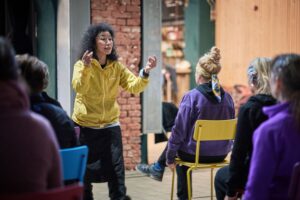
More than 100 older adults participated regularly in three weekly training groups. These sessions combined physical activity, artistic exploration, and social interaction. In addition, a two-hour weekly open-air class was introduced in the city park from May to October. This public format quickly became a key element of the project’s visibility and accessibility. Passers-by frequently joined spontaneously, including entire school classes who enthusiastically referred to the senior dancers as “the cool grandmas.” Such intergenerational moments revealed how dance can transform public space into a site of shared curiosity and informal cultural exchange.
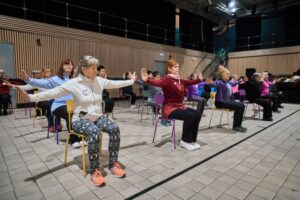
A defining component of Dancing Neighbours was the collaboration with Japanese artists Yoko Ando, Nami Kaigaichi, and Sonoko Kamata, who conducted four intensive workshop blocks over 5–6 days each in January, April, July, and October 2025. Their movement philosophy—rooted in precision, clarity, and embodied awareness—had a profound impact on the group. Participation in the workshops grew from approximately 35–40 dancers at the beginning of the year to more than 50 by October, demonstrating both the artistic quality and the motivational effect of this intercultural exchange.
Participants responded strongly to the Japanese teaching approach, appreciating the nuanced attention to detail, the depth of concentration, and the openness to improvisational structures. The Japanese choreographies introduced during these workshops now form an important part of the project’s collective repertoire. This artistic infusion expanded not only the dancers’ movement vocabulary but also their understanding of cultural influence, discipline, and expression.
In the spirit of promoting intergenerational collaboration, younger dancers from local training programs were regularly invited to join rehearsals and performances. Initially, differing learning speeds and stylistic expectations created hesitation on both sides. However, through shared creative processes, the generations began to recognize and value each other’s strengths. Older dancers contributed a sense of grounded presence and expressive depth, while younger participants brought speed, energy, and rhythmic agility. These interactions generated new choreographic ideas and strengthened mutual respect.
Throughout 2025, the Dancing Neighbours conducted 20 public performances, reaching an estimated audience of more than 10,000 people. Major appearances included the Opening Ceremony of the European Capital of Culture on 18 January (audience: approx. 5,000), the Lord Mayor’s New Year Reception, the Saxon Prime Minister’s summer celebration, and a performance at the Dresden State Parliament. The group also contributed to several large cultural events such as the Kosmos Festival, various street festivals, volunteer celebrations, and other Capital of Culture initiatives including the Apple Festival and the Kamenica musica dance festival.
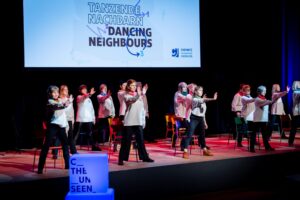
These performances significantly increased public awareness of the project and strengthened its position as a model for intergenerational cultural participation. National media reported on the initiative, and representatives from other European Capitals of Culture attended training sessions to learn more about the project’s methodology.
Several key insights emerged during the project’s development. One of the strongest outcomes was the confirmation that collaboration between professional dancers and older amateur dancers can produce both artistic quality and social impact. Older participants expressed pride in learning from professional choreographers and felt respected and valued for their willingness to engage deeply with contemporary movement practice.
The combination of weekly training sessions with intensive multi-day workshops proved to be an effective and motivating structure. Weekly classes offered continuity, routine, and social connection, while the workshops provided inspiration, challenge, and artistic renewal.
The project also demonstrated the strong social dimension of dance. Many participants regarded the group as a surrogate family, especially those living alone. The deliberate inclusion of a long break within the two-hour sessions created opportunities for conversation, mutual support, and the formation of friendships. Beyond rehearsals, participants began to engage in shared activities such as hiking, attending cultural events, or meeting in a newly opened local dance bar.
The collaboration with Japanese artists played a crucial role in expanding intercultural understanding. Participants reported increased curiosity toward Japanese culture, greater openness to unfamiliar movement styles, and heightened appreciation for the precision and emotional depth characteristic of Japanese contemporary dance traditions.
At the same time, the project revealed specific challenges in working with older adults. Reliable long-term planning is essential, as many seniors cannot manage short-notice changes. Digital communication methods are less effective for this demographic, making phone calls and printed schedules indispensable. Differences between the schedules of seniors and younger dancers also posed practical challenges, particularly when arranging joint rehearsals. Additionally, a waiting list was needed due to occasional health-related absences, ensuring continuity in the training groups.
The successful management of these dynamics required strong artistic leadership, professional project coordination, and dedicated volunteers, who supported participant registration, communication, and outdoor program logistics. Several volunteers eventually joined the dance groups themselves, illustrating the project’s inclusive appeal.
As the year concluded, Dancing Neighbours emerged as a visible and respected cultural initiative with strong potential for long-term continuation. The artistic enrichment provided by Japanese collaborators, the demonstrated social impact among seniors, and the growing intergenerational dialogue form a strong foundation for future development. International cooperation—particularly with Japan—holds significant promise for advancing both artistic depth and intercultural understanding in the coming years.
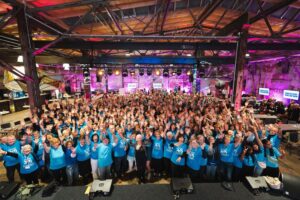
Future Development and Outlook
The presentation of Tanzende Nachbarn / Dancing Neighbours at Theater der Welt Chemnitz 2026 represents a decisive artistic milestone in the project’s development. Following two years of continuous work in participatory and intergenerational formats, the festival provides the framework for presenting the project at a new professional level and situating it within an international performing arts context.
Within Theater der Welt 2026, the project is planned to be shown in up to two performances of a newly developed choreographic production created in collaboration with the Japanese choreographer Yoko Ando and her team. These performances mark the transition from a primarily community-based format to a clearly articulated artistic work, while retaining the intergenerational core of Dancing Neighbours. The festival context enables international visibility and serves as a starting point for further local and international presentations.
Independent of Theater der Welt, and following the festival, a larger-scale development phase is planned at the Garagen Campus. This phase focuses on expanding participatory formats, workshops, and exchange programs and is conceived as a platform for sustained artistic and social engagement. The Garagen Campus will function as a site for longer-term processes, bringing together local participants with international artists and partners.
In this context, the project aims to strengthen connections with former and future European Capitals of Culture as well as additional international partners. The Garagen Campus is envisaged as a place where artistic practice, community building, and international cooperation can be further developed beyond the festival framework, allowing Tanzende Nachbarn / Dancing Neighbours to evolve into a transferable model for intergenerational cultural work in an international context.