Column
ColumnDojo Opera

Piccolo Opera Festival


The 2025 edition of the Piccolo Opera Festival — coinciding with Gorizia-Nova Gorica’s year as European Capital of Culture — resonated strongly, both for the variety of its program and the originality of its productions. As usual, the festival brought opera outside conventional theatres through “site-specific” stagings. Among the featured works, Gaetano Donizetti’s Rita stood out, a comic opera in one act, presented with a bold thematic and scenographic reinterpretation that embodied the festival’s artistic approach: cross-cultural contamination, internationality, and the involvement of young talent. The opera balances a comic tone with implicit social critique of gender roles—featuring a wife who “pre-emptively strikes” her husband—and includes refined ensembles and instrumental numbers characteristic of Donizetti’s genius. This small structure presents a challenge: how to keep it lively, engaging, and meaningful for contemporary audiences, without allowing setting or scenic devices to overshadow the music?
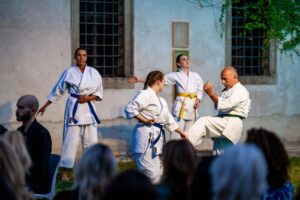
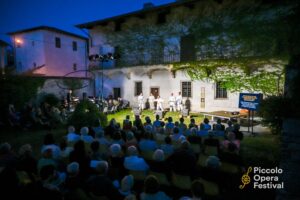
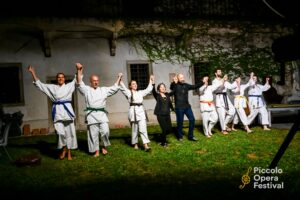
The Piccolo Opera Festival’s production relocated the action, traditionally set in an Italian inn, to a Japanese dojo. This directorial choice was motivated by several factors: a desire for cross-cultural contamination, reinforced by a partnership with EU Japan Fest under the GO!2025 framework; a symbolic intention where the world of martial arts prescribes non-violent and respectful approaches towards opponents, contrasting with hierarchical notions of force. Thus, the opera, which already addresses domestic violence and the struggle for liberation, gains a philosophical and symbolic reinterpretation. The staging sought visual and physical theatricality through choreographies, student extras, and elements of kendo—sticks and combat rituals—transforming the stage into a dynamic space in dialogue with the music. Within the festival’s context, this approach aimed to engage younger spectators and non-specialist audiences by merging Eastern culture with Western opera.
Such an audacious staging entailed risks. There was the risk of dissonance: if the setting diverges too much from the original text, dramaturgical coherence may be lost. The director had to find ways to “translate” Eastern gestures and symbols while remaining faithful to the libretto’s intentions. A balance between visual and musical elements was crucial: the stage could not be overloaded with choreography or symbolism to the point where singing was diminished. The dojo’s formal and geometric space had to remain flexible enough to host both intimate and confrontational moments without appearing artificial. Anna Etsuko Tsuri’s direction met these challenges by focusing on an essential aesthetic, with costumes and scenography recalling Japanese rituals like the tea ceremony and martial movements, while student extras added depth to the stage.
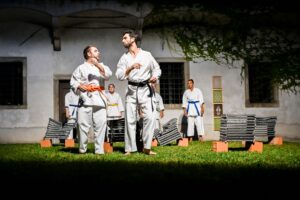
An additional innovation was the “Touch Tour” for blind and visually impaired audience members, curated by set designer Paolo Vitale. This initiative allowed them to experience scenographic elements, costumes, and instruments firsthand, enriching their multisensory perception of the opera. These choices demonstrated that the production aimed beyond mere exoticism; it sought meaningful contrasts between force and harmony, themes of mutual respect, and the inner conflict between domination and reconciliation. The three principal roles were performed by Claudia Ceraulo as Rita (cover Alisa Izak), Manuel Miro Caputo as Beppe, and Francesco Bossi as Gasparo. The MAKOTOKAI International school from Trieste participated as extras and martial arts coaches. Students from the Stage Management and Directing course of the GO! Borderless Opera Lab contributed fundamentally to the production.
Casting young performers and involving the GO! Borderless Opera Lab Academy as a training ground for emerging artists reinforced the festival’s workshop character. This approach brought freshness and openness to the interpretation but required strict artistic supervision to maintain balance and precision. Musical direction was entrusted to maestro Jimmy Chiang with the GO! Borderless Orchestra. The visual staging called for the conductor to act as a partner to the project, ensuring scenic rhythm—performers’ movements and choreographies—synchronized with the musical pulse. The choice of non-traditional venues, such as Dobrovo Castle and Palazzo Lantieri in Gorizia, highlighted the local territory, created immersive experiences, and reduced the distance between audience and opera.
Support from EU Japan Fest, the Friuli Venezia Giulia Region, private sponsors, and cultural partners was crucial in sustaining such an ambitious project. The result was a production that became an international showcase, attracting tourists from Austria, Germany, and cross-border audiences, a key element of the festival’s strategy. The staging of Rita at the Piccolo Opera Festival 2025 reflects a contemporary trend of creatively reinterpreting minor operatic repertoire, seeking connections with different cultures and current sensibilities. The production illustrates how musical theatre can become a dialogical medium—between Western and Eastern cultures, between space and gesture, and between audiences and emerging artists.
Looking ahead, the collaboration with Japanese partners opens promising perspectives. Building on the success of Rita, the festival aims to develop further exchanges with Japanese institutions, artists, and academies, fostering residencies, co-productions, and training programmes that deepen artistic dialogue between Europe and Japan. The shared values of discipline, harmony, and creative experimentation found in both opera and martial arts could inspire future projects exploring intercultural aesthetics and inclusive performance practices. In this sense, the 2025 edition may serve as the starting point of a lasting bridge between the Piccolo Opera Festival and Japan—a bridge where artistic innovation continues to thrive through mutual respect and curiosity.