Column
ColumnBeyond Geometry: Curating the Dialogue Between Frei Otto and Kengo Kuma

Kunstsammlungen Chemnitz


From the very first curatorial meeting, we sensed that “Beyond Geometry. Frei Otto x Kengo Kuma” would be more than a conventional exhibition—it would be an interdisciplinary experiment in dialogue, collaboration, and discovery. As organizers, our aim was to shape an exhibition that would bring two visionary approaches to light. From the outset, our goal was to honour Frei Otto’s pioneering work in lightweight, nature-inspired forms and Kengo Kuma’s democratic, material-sensitive architecture by forging an unexpected bridge between both architects. We envisioned a spatial narrative in which visitors could move seamlessly between Otto’s lightweight models and studies and Kuma’s timber lattices and structures, each display revealing how nature’s structural logic continues to inspire sustainable design.
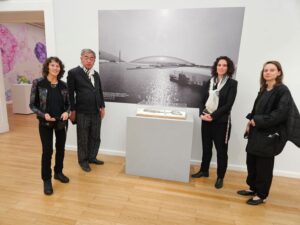
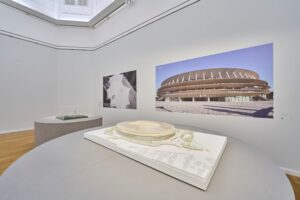
Kengo Kuma suggested five core principles of his philosophy around which the project should evolve: nature, lightness, softness, transparency, and sustainability. The exhibition unfolded across these five thematic chapters, each designed to immerse visitors in a distinct conceptual world. Throughout the exhibition, Kuma’s keywords thus guided our curatorial choices. “Nature” was present not only in the organic forms, but in the materials themselves—wood and fabric. For the “Lightness” section, we arranged models and photos of Frei Otto’s “Expo 67 pavilion” and “Hellabrunn aviary” under soft illumination to evoke their almost immaterial presence. On the opposite wall, Kengo Kuma’s “Mêmu Meadows” installation occupied a central plinth: a white membrane model captured its lantern-like glow. The topic of “Softness” emerged in the gentle curves of Otto’s pavilions and the delicate layering of Kuma’s structures. “Transparency” was both literal and metaphorical: we used translucent partitions and open layouts to foster visibility and dialogue. And the final section, “sustainability”, was a constant thread, from Otto’s resource-efficient designs to Kuma’s commitment to traditional craft and ecological responsibility. We underscored the ecological imperatives that guided both architects. Kengo Kuma’s “Breath/ng” origami sculpture stood as a testament to environmental design: its innovative fabric absorbs car emissions, suggesting practical applications for reducing urban pollution.
We also fostered archival materials and selected ZERO group artworks that echoed both architects’ purist aesthetics. Under the vaulted ceilings of the museum, Frei Otto’s translucent membrane models seemed to hover in mid-air, while Kuma’s warm cedar structures provided a tactile counterpoint. We realized that the exhibition space itself had become a living organism—a testament to the very principles of lightweight, responsive design we wished to showcase. To enrich the narrative, we invited regional artist Stephanie Lüning, famous for her soap performances, to contribute a site-specific installation. Her vibrant, ephemeral foam installations echoed the softness and impermanence central to both Otto’s and Kuma’s work. Lüning’s presence added a playful, tactile dimension that captivated audiences of all ages.
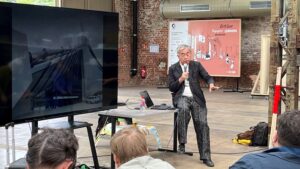
We designed a series of activities to animate our displays and engage diverse audiences. Model-building workshops invited families and architecture students to construct miniature pavilions, replicating Otto’s material frugality and Kuma’s craftsmanship. A collaboration with the Garagencampus enabled a Germany–Japan student exchange and facilitated debates on 22nd-century architectural visions, highlighting generational perspectives on sustainability. Educators reported that our workshops ignited genuine excitement for ecological construction principles. A standout episode unfolded during the public opening, when Kengo Kuma himself visited the exhibition and gave a talk about this work.
Reflecting on the project’s outcomes, we were struck by the richness of its cross-cultural dialogue. Ultimately, “Beyond Geometry” affirmed our conviction that exhibitions can be catalysts for innovation, education, and community building. By weaving together Otto’s visionary experiments and Kuma’s contemporary interpretations, we created more than a retrospective; we sparked an ongoing conversation about architecture’s potential to reflect ecological wisdom and social aspiration. Organizing “Beyond Geometry” taught use that curating architecture is not limited to showcasing monuments or drawings. It is about staging experiments, facilitating dialogue, and empowering people to touch, build, and reflect. By situating Frei Otto and Kengo Kuma in a shared narrative, we revealed an open architecture that stretches beyond geometry—one rooted in nature, lightness, softness, transparency, and sustainability, and alive in every hand-made bubble and woven panel. Ultimately, this exhibition has shown that when architecture embraces the fluid logic of nature, it becomes a bridge between generations, cultures, and disciplines. In the years to come, the lessons of Frei Otto and Kengo Kuma will continue to shape not only structures but also our collective imagination.