Column
ColumnJapanese artist MITSUME at Xcenter Nova Gorica

GO! 2025


The project MITSUME at Xcenter Nova Gorica aimed to foster meaningful cultural exchange between Japan and Slovenia through participatory art practices that connected young people, local creators, and professionals from the fields of manga anime pop style, mural painting, and live performances. It was a part of the official European Capital of Culture Nova Gorica–Gorizia 2025 program, within which Xcenter serves as a hub for creativity, technology, and intercultural dialogue.
During May and June 2025, the Japanese artist MITSUME—known for his vivid manga aesthetics and visual storytelling—spent two creative weeks developing new artwork inspired by the borderless identity of Nova Gorica and Gorizia, twin cities that embody shared history and new models of cohabitation. Based on the local fesature and symbols of two towns MITSUME designed with GO! 2025 team, led by Dr. Mojca Stubelj Ars and Matej Vidmar, two original manga characters that symbolically represent the two cities: one reflecting the dynamic, youthful energy of Nova Gorica (male character) and the other expressing the calm elegance and tradition of Gorizia female character.
These characters became visual ambassadors of our two cities among youth. To promote them within the community, we produced three types of black T-shirts printed with MITSUME’s designs, which were distributed for free to participating youth of the project. This gesture turned the project into a shared, wearable artwork—an expression of collaboration between Japan and Slovenia that transcended the linguistic and cultural barriers.
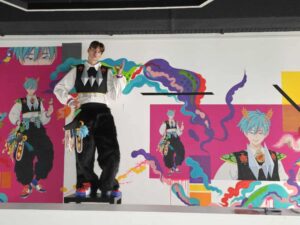
Building upon MITSUME’s design, we further developed one of the characters into a Slovenian-themed Cosplay manga costume that embodies several key symbols of national and local identity. His jacket features the rose, the emblem of Nova Gorica and the symbol of its nickname “the City of Roses.” On his chest, he carries a stylized image of the monument to Edvard Rusjan, the first Slovenian aviator born in this region, representing courage and innovation. His costume includes elements of the traditional “Kurent” outfit, originating from Ptuj—the oldest town in Slovenia—symbolizing vitality, protection, and festivity. The upper part of his attire reflects the national folk costume, with a shirt bearing sleeve patterns in the colors of the Slovenian flag. In this way, the character became a fusion of modern manga style and Slovenian heritage, presenting local culture through a contemporary visual language familiar to global audiences.
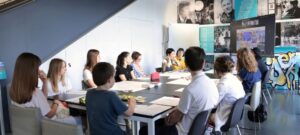
This project was combined with MITSUME engagment in Chemnitz 2025 European Capital of Culture. MITSUME conducted four manga-drawing workshops for young participants from Nova Gorica, Chemnitz (Germany), and Japan—two fully online and two hybrid session held live at Xcenter and Chemnitz. The workshops were funded by partners in Chemnitz 2025. Through drawing exercises and personal guidance, he encouraged participants to develop their own characters inspired by local stories and emotions. Most of the participants had never interacted directly with a professional Japanese manga artist before, making this experience a valuable insight into the artistic process and cultural philosophy behind manga anime style character creation.
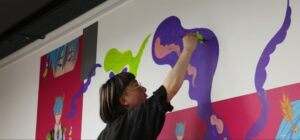
The highlight of the residency was the realization of two interior murals on the first-floor of Xcenter, integrating printed stickers of MITSUME’s characters designed in Japan. Mitsume painted the spirit of two characters with acryl colours on the walls creating unique and beautiful murals. The painting process itself was a public event—participants from the workshops and local community joined the event.
The second major outcome was a live painting performance titled “PianinoX”. During this event, MITSUME painted a restored old pianino with his signature imagery, transforming it into a public performance. The performance was accompanied by the Japanese dancer Eri Nishibara, whose delicate movements harmonized with MITSUME’s brushstrokes, creating a dialogue between sound, motion and image. The audience experienced a spontaneous artistic fusion of visual art and dance into unique performance, which left a lasting impression on all who attended. Today, the PianinoX remains a functional piano in Xcenter’s main hall, freely available for anyone who wishes to play it—a living reminder of the encounter between Japan and Slovenia.

From the organizer’s perspective, this collaboration demonstrated how artistic residencies can create lasting connections and tangible cultural outcomes. Working closely with MITSUME and Eri Nishibara required balancing cultural expectations, artistic needs, and logistical coordination—from preparing materials and spaces to managing translation, media communication and technical support. What impressed me most was the artist’s discipline, openness, and modesty, as well as Mitsumes ability to adapt to a new environment while keeping his artistic identity intact.
Through this project, I personally gained a deeper understanding of Japanese artistic sensibility, where simplicity and precision coexist with emotional depth. I also realized the importance of creating an environment that allows international artists to feel comfortable expressing themselves authentically. The collaborative spirit that developed among our team, participants, and visiting artists became a genuine example of how art can bridge distances and bring people together.
Looking toward the future, the MITSUME residency opened doors for further cooperation between Xcenter GO! 2025 and Japanese artists and institutions. The success of this project showed that cross-cultural artistic residencies can have strong educational and social impact, especially when they engage young people directly.
Ultimately, the MITSUME Residency at Xcenter Nova Gorica was not only about painting murals or creating characters—it was about building trust and curiosity between two cultures, allowing imagination to flow freely across borders. The murals, workshops, and PianinoX performance stand as symbols of that connection.