Column
ColumnThe Notion of Teire and the East-German Garage Culture



Garages, these tiny spaces aligned in rows and arranged in diverse spatial variants, still shape the urban landscape of many East German cities. Such is the case in Chemnitz, a post-industrial city of 250,000 inhabitants located between Dresden and Leipzig. As European Capital of Culture 2025, Chemnitz has made the socio-cultural potential of its approximately 30,000 garages one of the main themes of the ECoC program.
To understand why garages are such an essential part of East German cultural identity, it is important to look at their origins. During the GDR era, when owning a car was a rare and highly coveted achievement—sometimes requiring a wait of up to 15 years for a Trabant or Wartburg—people came together to build garages, ensuring a secure place to shelter these prized possessions. Many stories are told about these “heroic” times, when construction materials were scarce and everything had to be organized, borrowed, and shared. Members of these communities invested their own money and time—each contributing 300 to 500 working hours—to collectively build garage yards that sometimes held several hundred individual garages arranged in rows. The largest garage complex in Chemnitz consists of 1,247 garages, built by eight communities over several years in the 1970s.
This history brought people together and forged lasting bonds. For most East Germans, garages hold deep emotional value, often passed down for three generations. Similar processes existed in other socialist countries in the second half of the 20th century, where scarcity fostered creativity and self-empowerment. Beyond car storage, garages became there vital “third places” — retreats from the state, where people gathered, repaired things, socialized, and found moments of freedom.
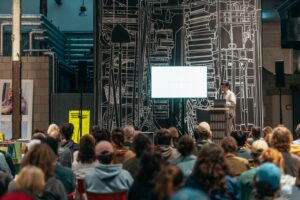
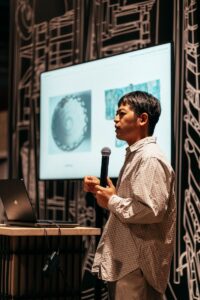
Against this background, the School of Garage (24–31 August 2025) was launched as part of #3000Garagen—a participatory, dialogue-based initiative with more than a dozen sub-projects, developed together with garage users and grounded in their life stories, skills, and experiences. Among the nine ateliers and international participants of the School of Garage, the presence of Japanese architect, artist, and scholar Takahiro Ohmura stood out as a distinctive voice. Invited as both keynote speaker and visiting tutor, Ohmura brought an external perspective that sharpened the understanding of Chemnitz’s garages as cultural and social spaces.
The School of Garage was curated and organized with Constructlab, the international platform of architects and designers dedicated to improving common urban spaces. This summer school functioned as a temporary, collective learning environment with and for over 60 international activists, architects, artists, designers, and urban developers. Its aim was to explore the legacy of local garage experts and, together with them, to develop new approaches to reimagining garage complexes as sites of sustainability, creative exchange, and collective futures—even if this sometimes meant producing utopian ideas.
The architect, artist, and scholar Takahiro Ohmura, one of the keynote speakers and a visiting tutor in one of the nine ateliers located in and around garages, was invited to provide a Japanese perspective on the social and spatial meaning of Chemnitz garages and to envision other approaches to them. Ohmura’s artistic practice, deeply integrated with his architectural work, focuses on collectivity, the transformative power of local histories, and the reconfiguration of urban and suburban spaces.
During his preparatory site visit in May 2025, he explored the Chemnitz garages and spoke with their users. He was especially interested in the persistence of materials stored in garages as bearers of memory, and the danger that these memories might vanish as practices of repair give way to ecological logics of recycling and renewal.
His keynote lecture opened the School of Garage. Here, he introduced the Japanese concept of teire (手入れ)—an ethic of ongoing care and attentiveness to continuity rather than repair after failure. This notion resonated strongly with local debates: with Luise Rellensmann’s call for “making heritage,” which argued for placing some garage complexes under monument protection to preserve their social and cultural role without freezing their living functions, and with Piotr Jakub Fereński’s metaphor of the empty garage as democracy without engagement or contribution.

Ohmura argued that placing teire in dialogue with the post-socialist reality of Chemnitz allows the garage to be reimagined as a cultural interface—a site where small gestures of care resonate with broader questions of sustainability, democratic participation, and civic imagination. In this light, a garage is no longer just a container, but a medium through which new forms of living together might be configured.
This perspective informed his work as a tutor within the Kintsugi Stadt Garage, an atelier run by the Urbane Liga, a German youth network dedicated to participatory urban design. Their collaboration began even before the summer school, producing a shared reader that laid the intellectual groundwork. During the atelier, Ohmura joined participants in investigating fractures and ruptures, both material and social. By casting molds of the cracks in garage walls, the group translated fragile lines into symbols of the community itself: traces of strain, but also openings for repair.
The notion of teire, specifically including the kintsugi strategy, became a strong symbol of the need for shared, ongoing efforts to recognize, question, and sustain cultural practices and social bonds. It suggested that democracy itself depends on such everyday gestures of care, carried out in spaces as humble, unassuming, and quietly ordinary as the garage complexes of Chemnitz.
From this perspective, the future legacy of #3000Garagen lies in the continuity of care and the institutionalization of participatory practices beyond the temporal frame of the European Capital of Culture year. The processes of activation initiated by #3000Garagen and the School of Garage must not be understood as temporary interventions but as prototypes of long-term cultural infrastructure. Sustaining them requires not only policy support and resource allocation but also an ethical commitment to everyday forms of maintenance, dialogue, and reciprocity—the very essence of teire. In this sense, community management evolves into a cultural methodology, translating the act of caring for spaces into the act of caring for relations. If carried forward, such practices may allow the garage to remain a dynamic interface of collective memory and social imagination, offering a model for post-industrial resilience and democratic renewal in Europe.
To what extent Takahiro Ohmura’s input, both through his keynote and his contributions to the learning process during the School of Garage, could serve as an inspiration for further activities or collaborations among the international participants is difficult to gauge. The processes of mutual intellectual exchange and inspiration are often intangible and subtle, especially in the absence of a stable institution responsible for sustaining and facilitating them. On the other hand, the power of lived experience and the joy emerging from such collaborative initiatives as the School of Garage can be transformative. I firmly believe that this week of intensive collaboration in and around East German garage yards in Chemnitz was a truly unique and lasting experience for all involved.